Online community platforms: which one should your brand choose? (2026 comparison)
Facebook group, Discord, Circle, Skool or a forum on your store, our 2026 comparison of online community platforms to pick the right one for your brand.
An online community platform is where your customers meet to talk to each other. The one you pick decides who owns the conversations, how closely the community is tied to your store and how much time you will spend running it. This article compares the options, from social networks to dedicated community software, then presents the solution we built for Shopify brands.
What is an online community platform?
An online community platform is an online tool where a group of people post, reply to each other and gather around a shared interest. For a brand, it is the space where customers talk to each other, ask their questions and describe their experience.
These platforms fall into three families, namely the social networks and messaging apps your customers already use, dedicated community software such as Circle or Discourse and forums built into your own website. If you are starting from scratch, our guide to community marketing explains what a community brings to an e-commerce brand.
How to choose the right community platform
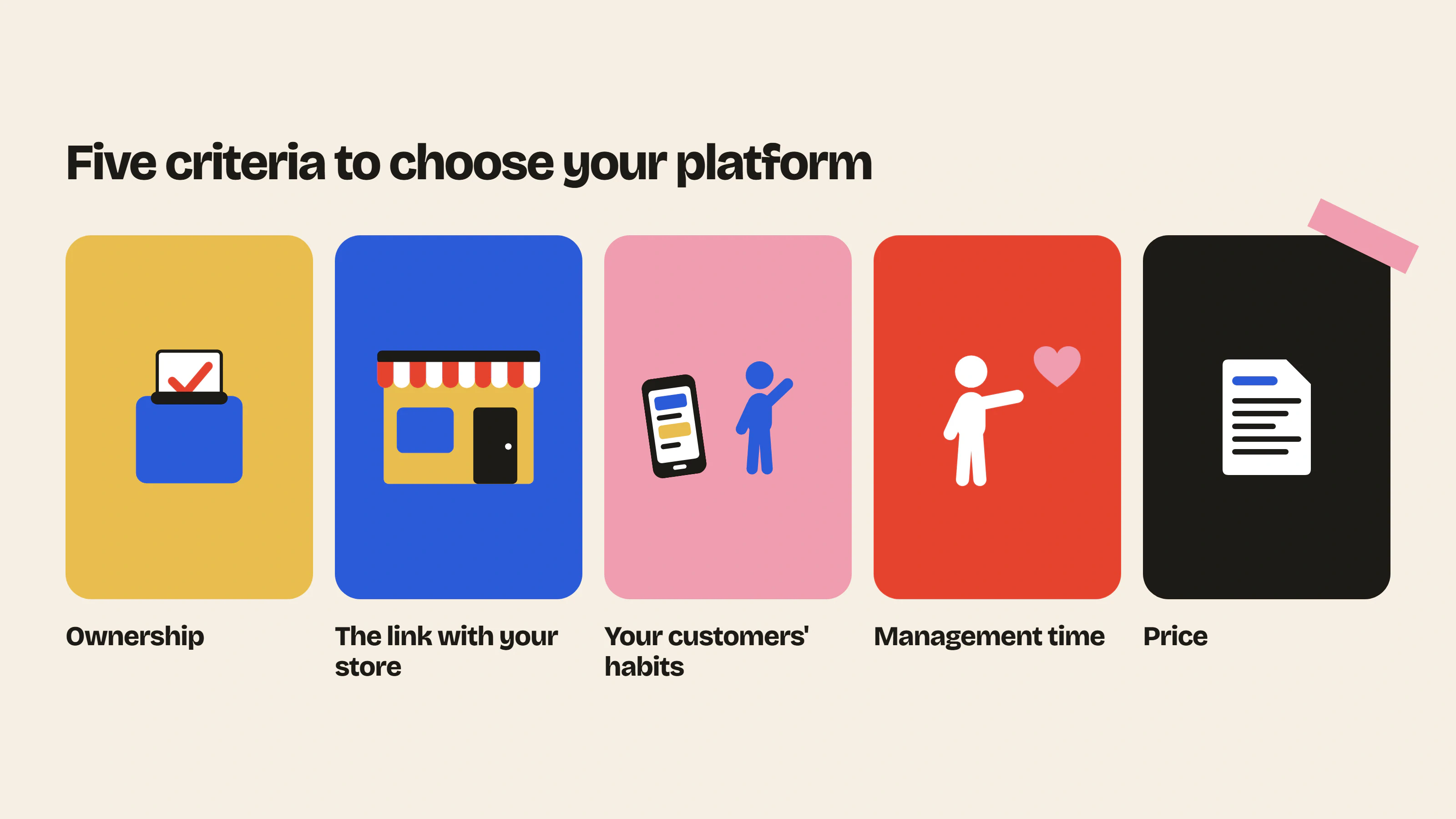
Before comparing tools, decide what matters to you. Ownership comes first, meaning what happens to the conversations and the data if the platform changes its rules. The link with your store comes next and tells you whether members are one click from your products. Your customers’ habits count too, since they already use certain tools and will balk at creating a new account. Management time depends on the moderation and engagement tools on offer. And the price can be free, fixed or rising with the number of members.
Also look at the features you need. Online courses, paid events and memberships are the strength of some platforms and are of no use to a brand that sells products.
Social networks and messaging apps
The Facebook group
It is the historical choice for many brands. It is free and many customers already have an account. But the reach of each post depends on the algorithm and the conversations live on Meta’s servers, not on your site. Meta offers no tool to export a group’s discussions, since Download Your Information only covers your own account. If Facebook changes its rules or closes your group, the history disappears.
Discord
Discord suits young audiences and gaming-adjacent brands. Conversations move fast, with voice channels and live events. But a useful answer quickly gets buried in the flow of messages. And members are Discord accounts with no link to your orders. We cover its strengths and limits in our article on Discord marketing for e-commerce brands.
WhatsApp and Telegram
These messaging apps are easy to use and create a sense of closeness. WhatsApp Communities group several topic groups and an announcement group, with up to 2,000 members (WhatsApp Help Center). But they are built for live conversation, so beyond a few dozen active members topics get mixed up and last week’s answer becomes impossible to find.
Dedicated community platforms
Dedicated community software offers complete spaces, often with courses, events and paid memberships. It suits trainers, creators and companies that sell knowledge. For an online store, these tools share two limits, since the community lives on a site other than yours and your customers have to create a new account. Here are the five best known (prices taken from their websites on October 29, 2026, in US dollars, excluding tax).
Circle
Circle combines discussions, courses, live events and paid memberships. It mainly targets creators and digital entrepreneurs who sell knowledge or a subscription. The first paid plan, Professional, costs $89 per month billed annually after a 14-day free trial. There is no free plan. Circle has no Shopify integration, so the connection goes through Zapier (Circle pricing).
Skool
Skool hosts free or paid communities with courses, videos and live calls. It targets creators and experts who want to earn an income from their community. The Hobby plan costs $9 per month plus a 10% fee on each sale, the Pro plan $99 per month plus 2.9%. The trial lasts 14 days and there is no free plan (Skool pricing). Connections to other tools go through Zapier, on the Pro plan only.
Mighty Networks
Mighty Networks brings together community, courses, events and paid memberships, with an AI assistant to help you build your space. Mostly used by creators and coaches, it also targets brands that engage their customers or ambassadors. The Launch plan starts at $79 per month, or $950 per year, after a 14-day free trial (Mighty Networks pricing). It has no Shopify integration and a menu link can only send members to your store.
Discourse
Discourse is open source forum software, used by more than 22,000 communities according to its publisher, often for customer support and developer communities. It is free if you host it yourself, which takes a server and technical skills. Official hosting includes a free plan limited to 2 staff seats and 500,000 page views per month, then a Pro plan at $100 per month (Discourse pricing). There is no official Shopify integration, so connecting it to your store takes the API or custom development.
Bettermode
Bettermode lets you launch a branded customer community without code, with discussions, a feed, events, a knowledge base and feature requests. It mainly targets marketing and customer success teams at software companies. The Starter plan starts at $149 per month billed annually, after a 14-day trial (Bettermode pricing). No Shopify integration is mentioned, but Zapier makes the link.
None of these five tools lists a native Shopify integration on its website. So your customers get an account separate from their customer account and the community does not know what they bought.
Forums built into your Shopify store
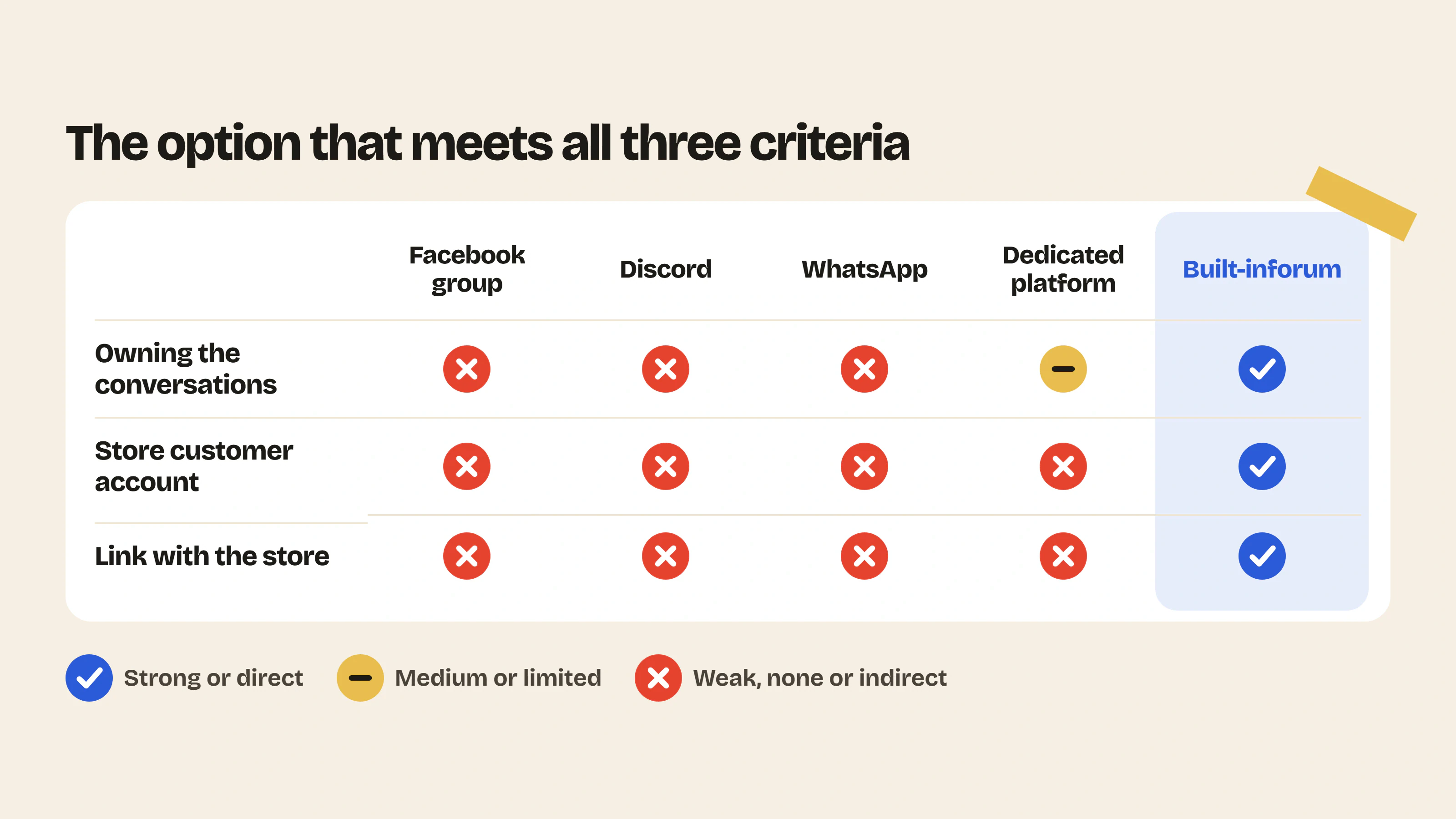
The community lives directly on your site, in your colors. Customers log in with their usual account, conversations stay on your store and products are one click away. It is the only option that combines ownership of the conversations with a direct link to your sales. The downside is that you have to bring customers who spend their time on social media over to your site. We explain what it changes day to day in why add a forum to your Shopify store.
Several apps on the Shopify App Store add a forum to a store, with very different approaches. We compared them in our selection of the best Shopify forum apps. To see what a community would look like on your own store, try our free Shopify community simulator, no sign-up needed.
Community platforms compared
| Criterion | Facebook group | Discord | Dedicated platform | Built-in forum | |
|---|---|---|---|---|---|
| Where do conversations live? | On Facebook | On Discord | In the messaging app | On the vendor’s site | On your store |
| Link with your store | Indirect | Indirect | Indirect | Separate | Direct |
| Account needed | Facebook account | Discord account | Phone number | New account | Existing Shopify customer account |
| How conversations are organized | Group feed and topics | Channels and threads | Chat thread | Spaces, courses and events | Categories and topics |
| Price | Free | Free | Free | $9 to $149 per month for the first paid plan | Free plan, then a subscription |
| Best for | An entry point | A young, real-time audience | A small, close-knit group | Courses and creators | Brands that sell products |
Insider Club, the forum built for Shopify stores
To be clear, Insider Club is our app. We built it because none of the options above met the needs of e-commerce brands.
A forum that reflects your brand
The forum fits into your Shopify theme. You set the logo, banner, colors, fonts and rounded corners yourself. Your customers stay in your brand’s world instead of landing on generic software.
Customers become members in one click
Customers logged in to their Shopify account automatically become members, with no new password or sign-up form. Other visitors create a customer account, just as they would to place an order.
Public and private spaces
Each category can be public, private or reserved for certain roles. The whole forum can also be password-protected. For example, the peer support category can stay open to everyone while a VIP category in the same forum is reserved for your best customers.
Moderation and engagement
Spam detection, a banned-word list, member reports and bans let you control what gets published. To keep conversations going, there are polls, subcategories and product cards, plus photos and video links in posts. Analytics and email alerts show active members and what needs your attention. To estimate how much time peer support will save your team, use our customer support savings calculator.
Insider Club has a free plan and a paid plan with a 14-day trial, both detailed on our pricing page.
Which community platform for which brand?
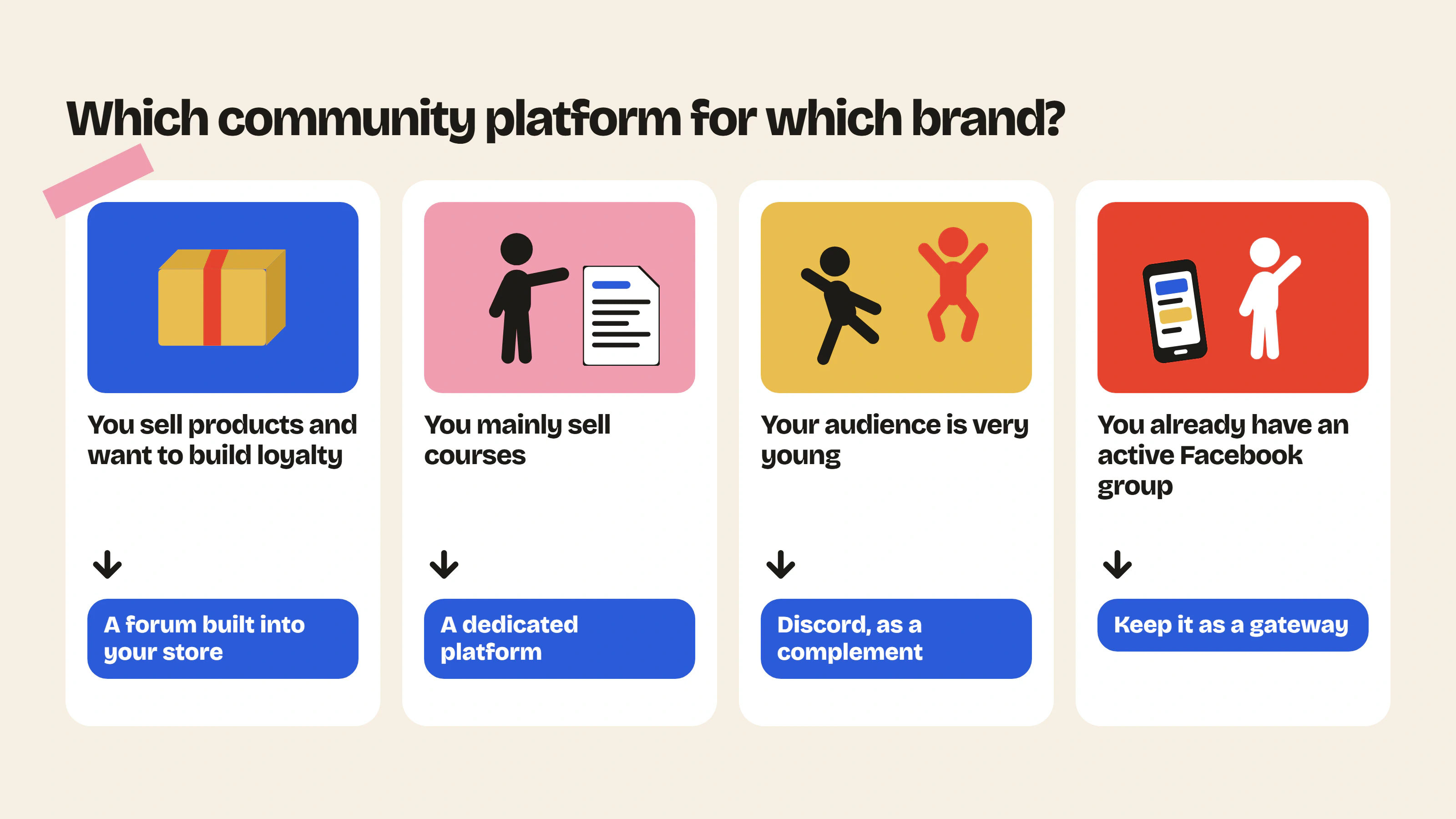
| Your situation | Our advice |
|---|---|
| You sell products and want to retain customers | A forum built into your store like Insider Club, the best balance between owning the conversations and driving sales |
| You mainly sell courses | A dedicated platform such as Circle, Skool or Mighty Networks, if you accept that it lives outside your site |
| You run a community of employees, partners or alumni | A dedicated platform, or Discourse for its advanced forum features |
| Your audience is very young and used to real time | Discord, alongside a main space on your store |
| You already have an active Facebook group | Keep it as an entry point and bring in-depth discussions back to your site |
Our Shopify forum vs Facebook group vs Discord page compares these three options in detail. Once you have chosen a platform, the hard part remains, which is giving customers a reason to come back. Our guide to the 5 types of content that keep an e-commerce community alive explains what to post during the first weeks. And to launch the community step by step, follow our guide to building a brand community.
FAQ
What is the best platform to build a community?
For an e-commerce store, the best choice is a forum built into your site, because it keeps the conversations on your own site and one click from your products. To sell courses, a dedicated platform is a better fit.
Is there a free community platform?
Yes, a Facebook group, a Discord server or a WhatsApp community are free, but the conversations live on their platforms. Discourse is free if you host it yourself and its official hosting has a limited free plan. Insider Club also has a free plan, with unlimited members and posts, to launch a forum on your Shopify store.
Can I use several platforms?
Yes, you can use social networks as an entry point and your site as the main place where discussions happen. Tell your customers clearly where to find the answers that need to last.
Can I build my own community platform?
Yes, either by installing open source software such as Discourse on your own server, which takes technical skills and hosting, or by adding a forum to your existing site. On Shopify, an app is enough, with no development.
Build your community on your store
Insider Club adds a forum in your colors to your Shopify store, where your customers are automatically members and every discussion stays useful to the next customers. To decide, you can see the features or view pricing.
- Community previewPaste your store URL and see what your forum would look like, with your colors and your products.Use the tool – Community preview
- Customer support cost savings calculatorThe hours and dollars saved when your community answers your customers' repetitive questions.Use the tool – Customer support cost savings calculator


 Install on Shopify