Social commerce: definition, examples and how to get started
Social commerce means selling through social media. Definition, TikTok Shop, Instagram, live shopping, examples and how to get started with your ecommerce brand.
Your customers discover more and more products on TikTok or Instagram. They see a video, read the comments and some of them buy right away. That’s social commerce.
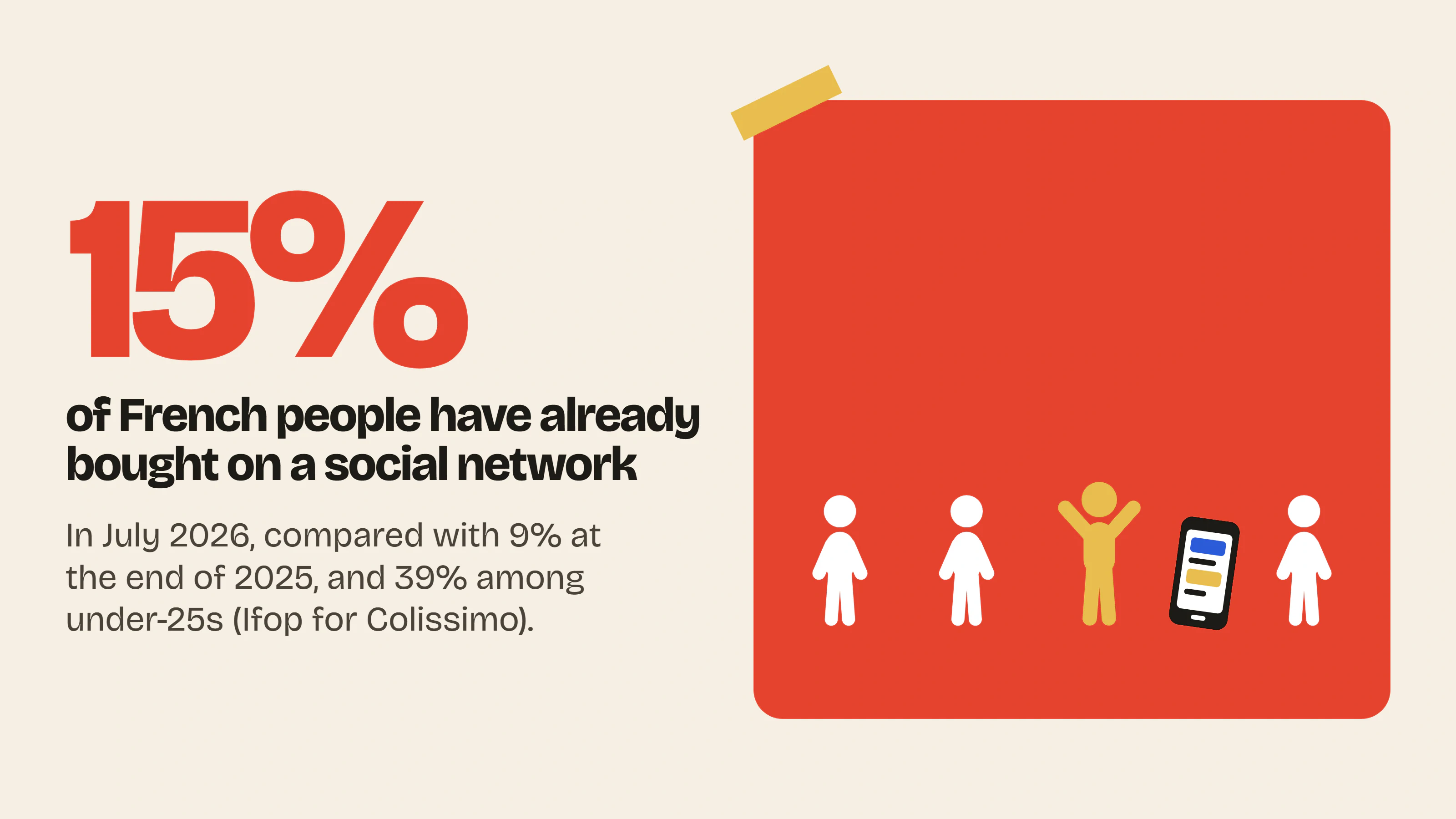
In France, it took off when TikTok Shop arrived in 2025. Today, 15% of French people have already bought directly on a social network and it’s 39% among under-25s (Siècle Digital).
In this article, we explain what social commerce is, which platforms to sell on, how much it costs and how to connect them to your store. We also show you how to do social commerce on your own site with Insider Club.
What is social commerce?
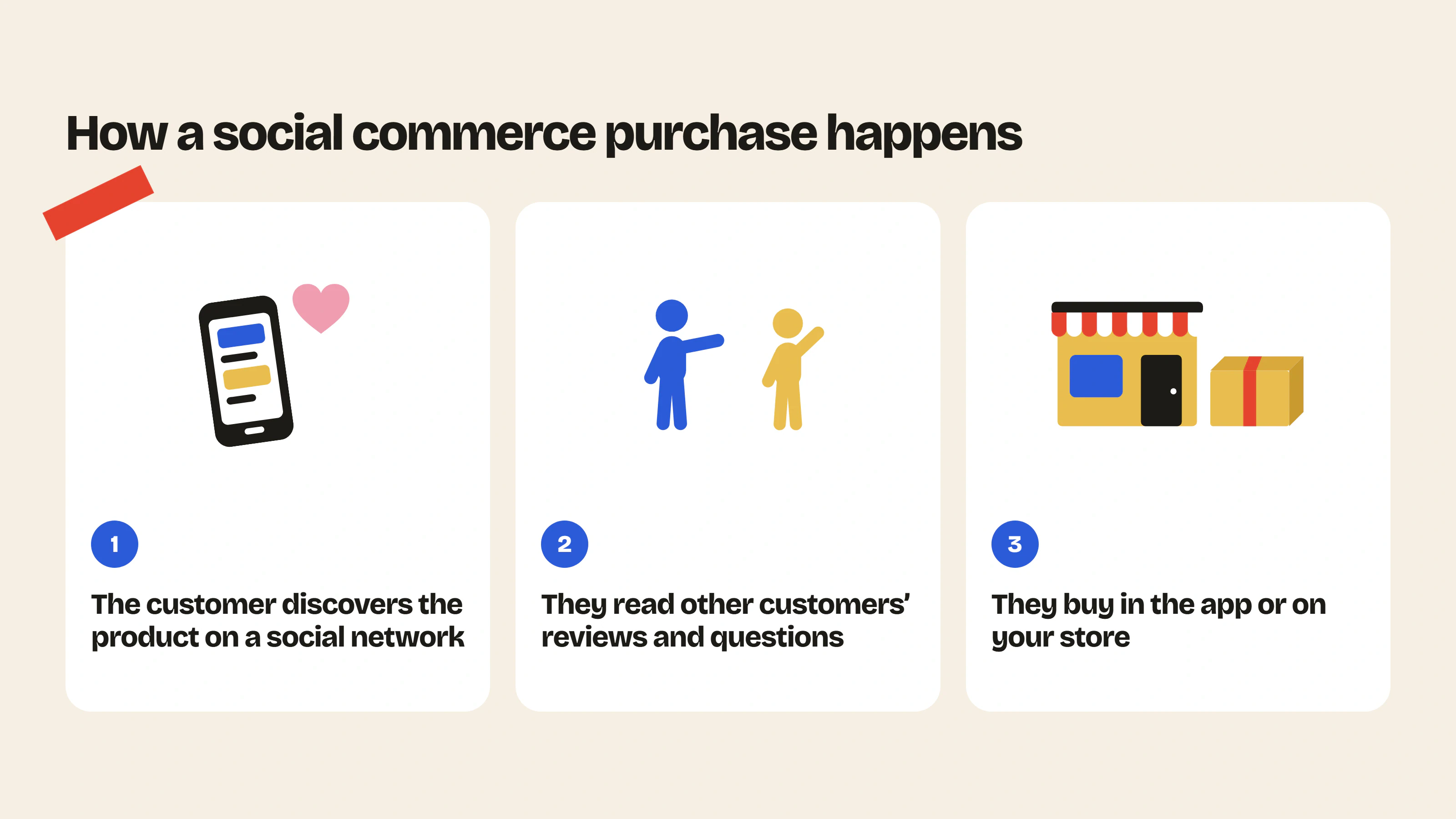
Social commerce means selling your products through social media. The customer discovers the product in a video, a post or a live stream. Then they buy it directly in the app (like on TikTok Shop) or on your site in a few clicks.
The “social” part is the other customers. Their comments, their reviews and their videos with the product reassure people before they buy.
Social commerce, ecommerce, social selling: what’s the difference?
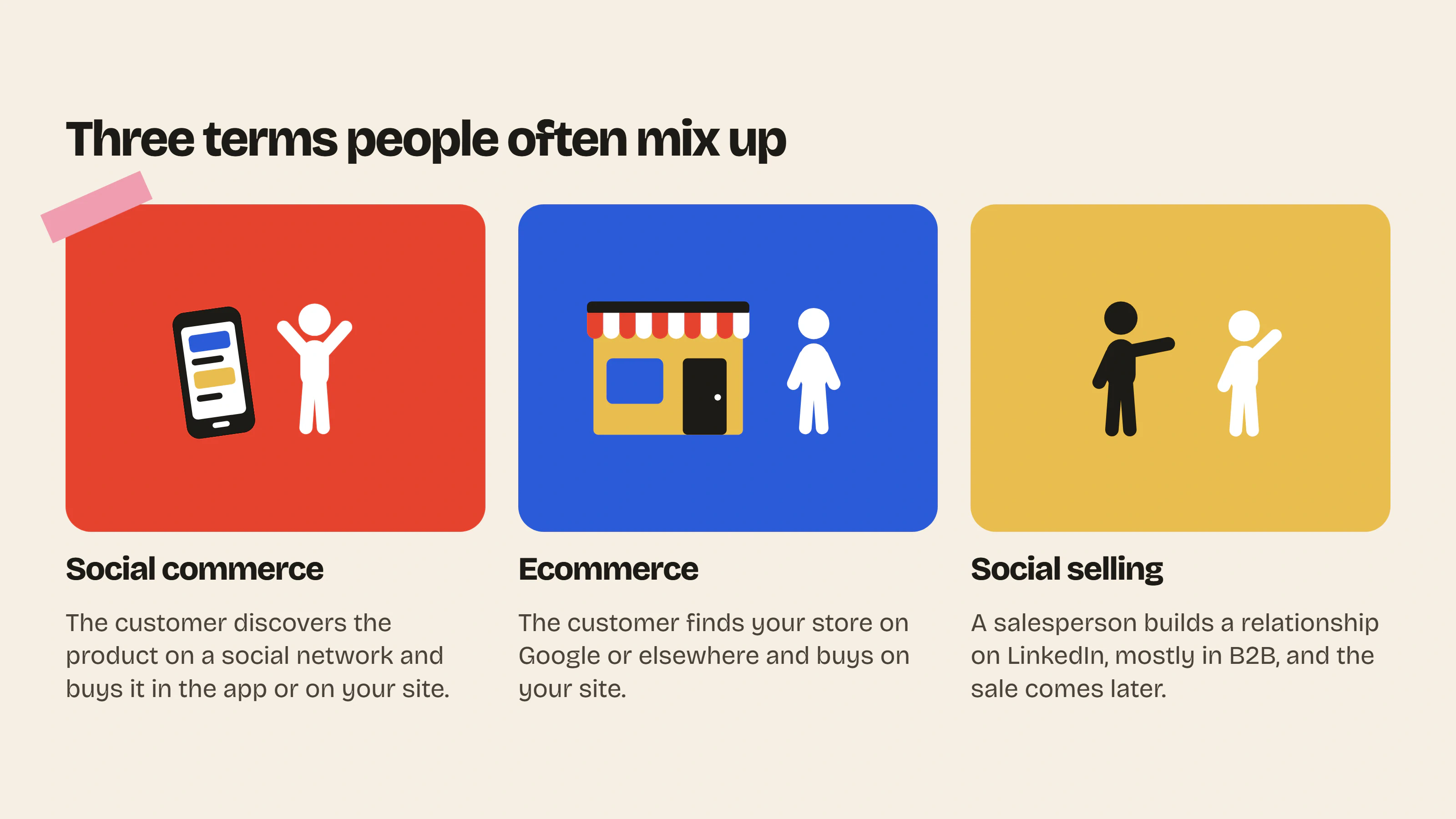
The three terms look alike and people often mix them up. Here’s what sets them apart.
| Social commerce | Ecommerce | Social selling | |
|---|---|---|---|
| Where does the customer discover the product? | On a social network | On Google, a marketplace or your site | On LinkedIn or a social network |
| Where do they buy? | In the app or on your site | On your site | Elsewhere, after a conversation |
| Who is it for? | Brands that sell to consumers | All stores | Mostly B2B |
| An example? | A TikTok video with the product to buy | A product page on your store | A salesperson who talks with a prospect on LinkedIn before a meeting |
Social selling is mostly used to build a relationship with prospects in B2B. If your ecommerce brand sells to consumers, social commerce is the one that concerns you.
How big is social commerce?
In the United States, social commerce sales reached $87 billion in 2025 and should pass $100 billion in 2026. That’s still 6.9% of ecommerce, but the share grows every year. And TikTok Shop already accounts for almost a fifth of it (Retail Dive).
In France, it’s more recent but it’s moving fast. French people who had already bought on a social network were 9% at the end of 2025 and 15% in July 2026 (MoneyVox). To give you an idea of scale, French ecommerce as a whole was worth €196.4 billion in 2025 (CB News).
Which platforms should you sell on?
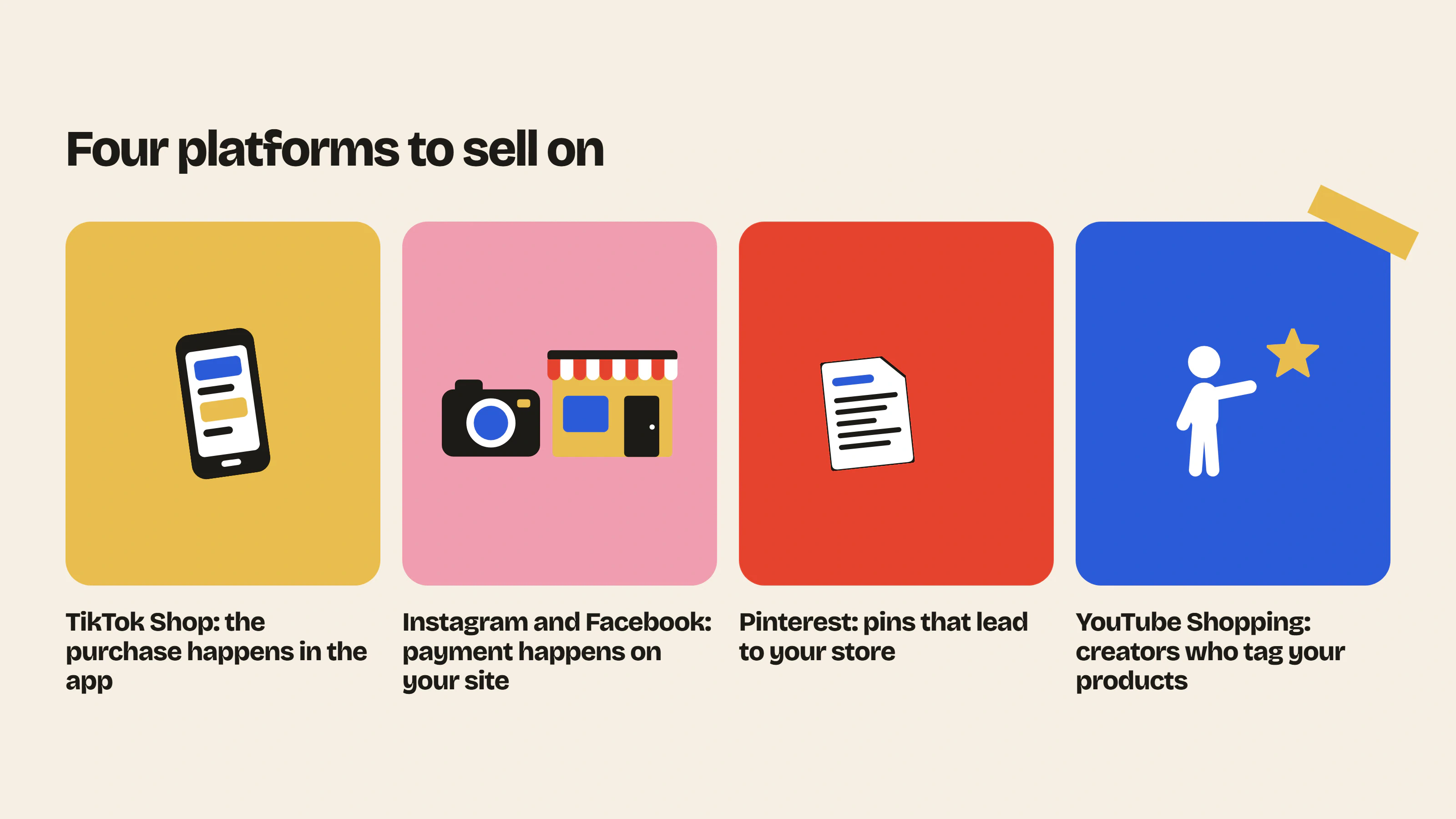
The platforms don’t all work the same way. On some, the customer buys without leaving the app. On others, they finish their purchase on your site.
TikTok Shop
TikTok Shop has been open in France since March 31, 2025 (TikTok). The customer buys without leaving the app, from a video, a live stream or the shop tab. The platform already has more than 33,000 sellers in France.
As for cost, TikTok takes a commission on each sale. It went from 5% to about 9% for most categories in January 2026 (E-Commerce Nation). The rate depends on your category, so check it in your seller center before you start.
Instagram and Facebook
Since September 2025, you can no longer pay directly in Instagram or Facebook. Meta removed in-app checkout from its shops (Meta). The customer still sees the product in the app, then they’re sent to your site to finish their purchase.
For you, it’s rather good news. The order lands on your store, with your customer, their email and their cart.
On Pinterest, your products show up as pins with their price and the click leads to your store. The Pinterest app is free, you only pay for ads if you run them. It’s a good channel for home decor, fashion or cooking, because people go there precisely to look for ideas.
YouTube Shopping
YouTube Shopping arrived in France on October 13, 2026 (Google). Creators can now tag products in their videos, their Shorts and their live streams and earn a commission. For a small brand, it’s mostly one to keep an eye on over the coming months.
What about live shopping?
Live shopping means selling live, on video, with a link to buy during the broadcast. Facebook shut down its live shopping in 2022 (Blog du Modérateur). The format came back with TikTok: in September 2025, live streams made up 16% of TikTok Shop sales in France (E-Commerce Nation).
You can also run live streams on your own site, with tools like Caast. We come back to this further down with the Grain de Malice example.
How do you connect social media to your store?
Each platform has its official app to install on your store. You manage your catalog in one place and you don’t have to recreate your product pages.
| Platform | App to install | App price | Synced data | Where does the customer pay? |
|---|---|---|---|---|
| TikTok Shop | TikTok | Free, commission on sales | Catalog, orders and inventory | In TikTok |
| Instagram and Facebook | Facebook & Instagram by Meta | Free | Catalog | On your site |
| Free, you pay for ads | Catalog | On your site |
For TikTok Shop, there are a few steps: install the TikTok app, create or connect your seller account, verify your business, then sync the catalog and set up shipping (TikTok guide).
The limits of social commerce
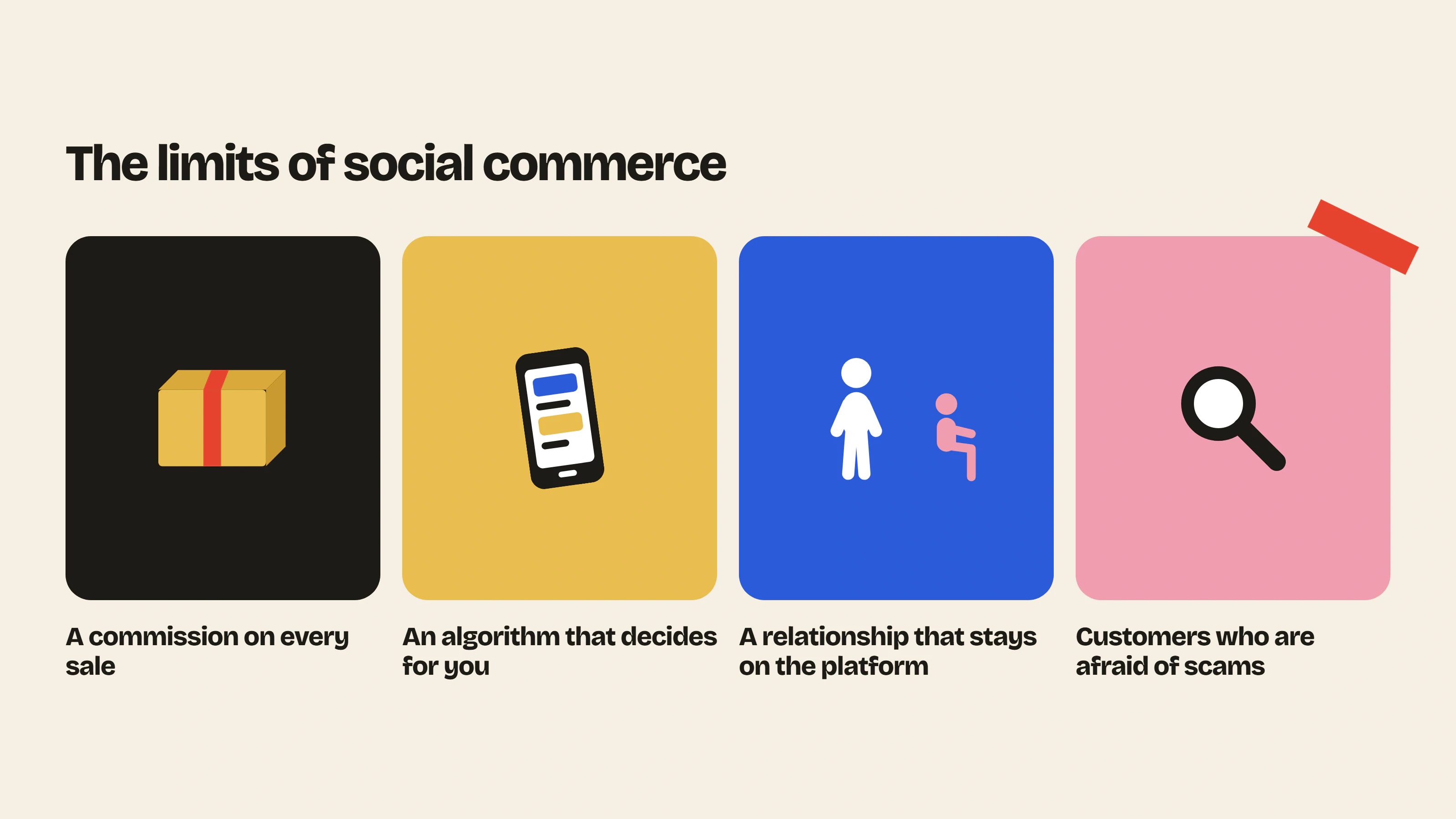
Social commerce has its downsides too and it’s better to know them before you start.
The first one is cost. On TikTok Shop, each sale costs you a commission, on top of ads if you run them. Before lowering your prices for the platform, do the math with your margin, for example with our break-even ROAS calculator.
You also depend on the algorithm. A video can sell a huge amount one day and nothing at all the following week. And the platform can change its rules overnight, like Meta did when it removed checkout in Instagram.
Part of the relationship stays on the platform. The comments, the followers and the history of your conversations stay with TikTok or Instagram and you don’t get them back on your store.
And then there’s trust. Among French people who have never bought on a social network, 56% are afraid of being scammed (MoneyVox). Reviews and photos from other customers help a lot to reassure them.
How do you do social commerce on your store with Insider Club?
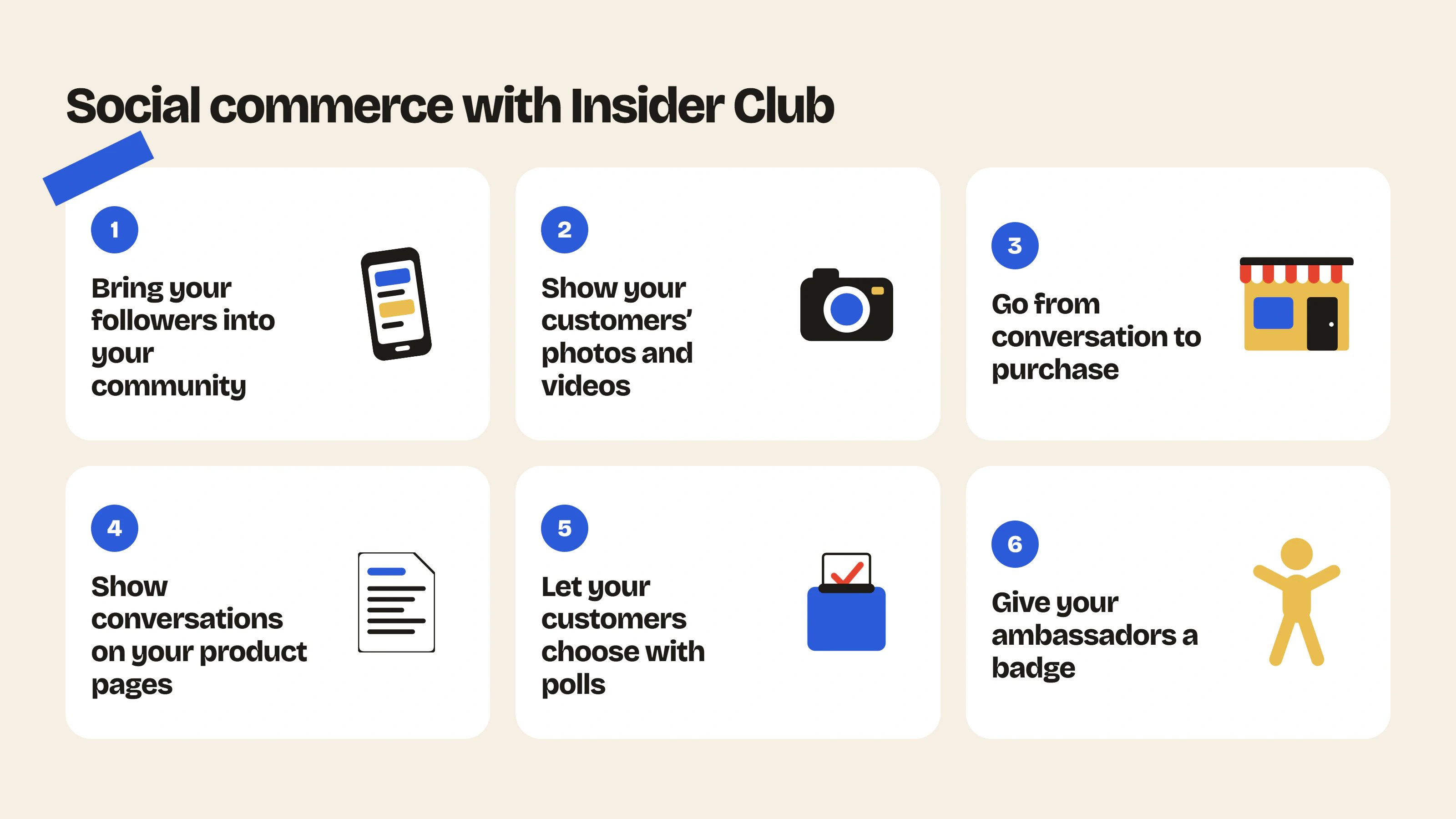
Social media is perfect for getting your products discovered. But conversations between customers can also happen directly on your store, next to the cart.
That’s what Insider Club does: a forum in your own colors, added to your store, where your customers ask their questions, share their photos and give their opinion. Here’s how to use it for social commerce.
Bring your social media followers into your community
Put your community link in your Instagram or TikTok bio, in your stories and at the end of your live streams. Customers logged in to your store are members automatically, they don’t have an account to create. They go from the video to a conversation with other customers, on your site.
Show your customers’ photos and videos
Your members can add photos and video links to their posts. A customer who shares their TikTok video in your forum is content that stays on your store, visible to visitors who are still hesitating. We explain why this content created by your customers also matters for your SEO.
Go from conversation to purchase
Your team can add product cards to its posts. When you answer a question or present a new product, the product shows up with its page and the customer opens it in one click.
Show conversations on your product pages
Insider Club can display your community’s latest posts on any page of your store, including your product pages. Visitors see that other customers are talking about the product, like in the comments under a video.
Let your customers choose with polls
Ask your customers to choose the next color or the next scent with a poll. Then announce the result in the forum and on your social media.
Give your creators and ambassadors a status
Spot the customers who make videos of your products. Give them an “Ambassador” badge and open a private category for them, to show them new products before anyone else.
Pin your live stream or your launch
You can pin up to three posts at the top of the forum, for example the announcement of your next live stream or of a new product. Email notifications then bring members back when someone replies to them.
Photos, video links, polls, roles and badges and private categories are part of the Growth plan, at $19.99 a month with a 14-day free trial. The details of each plan are on the pricing page. You can install Insider Club from the Shopify App Store and see all its features.
Social commerce examples
For more ideas, we’ve also put together 15 brand community examples. Here are a few brands that do social commerce.
Mela’Aura: creators and live streams on TikTok Shop
Mela’Aura is a French skincare brand for Black and mixed-race skin. It launched on TikTok Shop with live streams and creators, to whom it sends around fifty samples a week. In the first quarter of 2026, the brand had more than 4,600 orders and €233,000 in sales on TikTok Shop (TikTok).
Grain de Malice: a live stream every five weeks
Fashion brand Grain de Malice ran 21 live streams in two years on its site with Caast, roughly one every five weeks (mind Retail). The return on investment of its live streams doubled between 2024 and 2025.
CABAIA and IZIPIZI: there from the opening
CABAIA accessories and IZIPIZI glasses were among the French brands present at the launch of TikTok Shop in France (TikTok).
Magic Spoon: TikTok Shop run from its store
American cereal brand Magic Spoon connected TikTok Shop to its store and reuses its product pages. All TikTok orders arrive in the same place as the others (case study), so it doesn’t have to manage two catalogs.
Mississippi Candle Company: one viral video
This small American candle brand has been selling on TikTok Shop since 2023. After one of its videos went viral, its sales grew by more than 600% in a year. It now employs more than 20 people (Modern Retail).
Where should you start, depending on your store?
| Your store | Where to start? | Why? |
|---|---|---|
| Fashion, beauty, accessories | TikTok Shop and Instagram | Your products look good on video |
| Decor, home, kitchen | Pinterest and Instagram | People look for ideas there before buying |
| Technical products or products that need advice | Your community on your store | Your customers have questions before buying |
| Small brand just starting out | Instagram and your community | It’s free and you keep your customers |
| Brand that already works with creators | TikTok Shop, with affiliates and live streams | Your creators sell for you |
You don’t need to be everywhere. Start with one channel and look at what it brings in once the commission and ads are deducted. Then add another one.
FAQ
Is TikTok Shop available in France?
Yes, since March 31, 2025. It’s also open in Germany, Italy, Spain and Ireland, and since June 2026 in Belgium, the Netherlands, Austria and Poland.
How much does TikTok Shop cost a seller?
The TikTok app is free, but TikTok takes a commission on each sale. It’s about 9% for most categories since January 2026. Check your rate in your seller center and add your shipping costs and any ads you run.
Can you still pay directly on Instagram?
No, not since September 2025. The customer sees the product in Instagram or Facebook, then finishes their purchase on your site.
Is social commerce right for small brands?
Yes, the social media apps are free and you can start with a single channel. A small brand can even answer the comments itself and build a relationship with its first customers, on social media as well as on its store.
- Break-even ROAS and profitability calculatorYour minimum ROAS, margin per order and the number of sales needed to be profitable, in seconds.Use the tool – Break-even ROAS and profitability calculator
- Community previewPaste your store URL and see what your forum would look like, with your colors and your products.Use the tool – Community preview

 Install on Shopify