Ecommerce customer retention: 12 strategies that work
What ecommerce customer retention is, how to measure it and 12 strategies that work: post-purchase, rewards, community. With examples and mistakes to avoid.
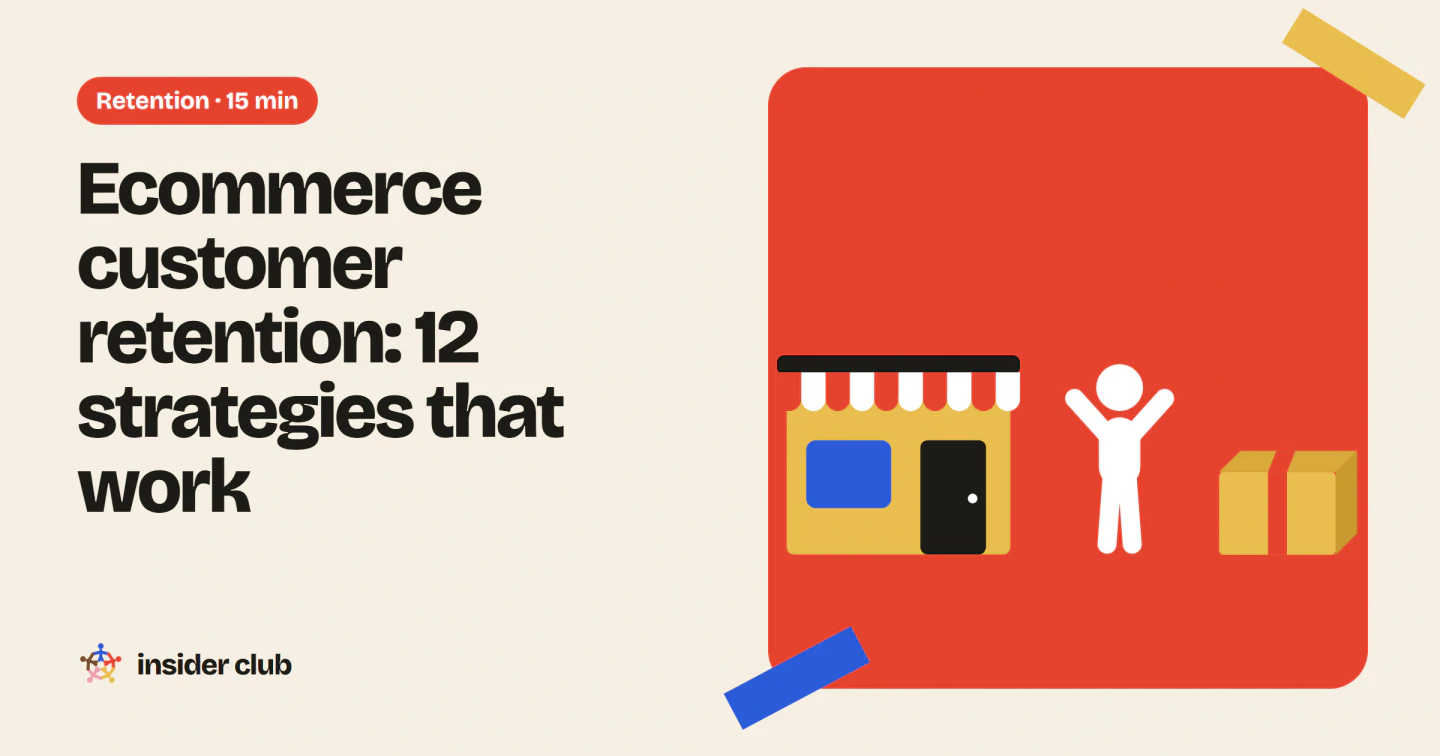
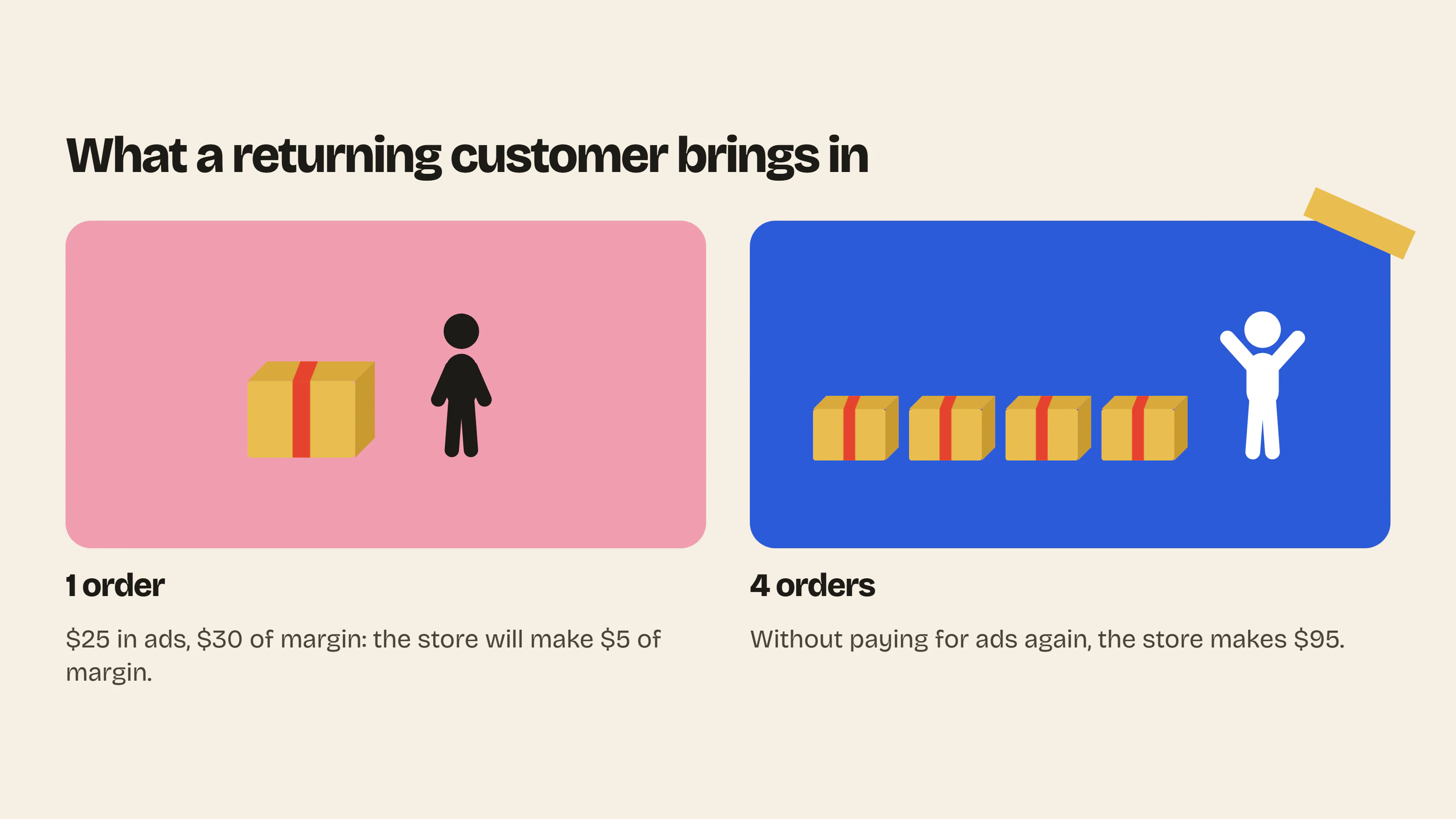
Take a store that pays $25 in ads to win a customer and sells a product on which it keeps $30 of margin. If the customer buys only once, the store will make $5 of margin. If they come back three more times without the store paying for ads again, it makes $95.
How do you get the next orders? That’s what this article on ecommerce customer retention is about. For a small online store, that’s often where profit is made. Yet it’s easy to spend more time on acquisition than on the customers you already have (an ad campaign, at least, shows results within the week).
So here’s what we recommend to brands that want their customers to come back. You’ll find the four numbers to track, 12 strategies ranked from the simplest to the most ambitious and the mistakes we see most often.
What is customer retention in ecommerce?
Definition
Customer retention is everything you do so that a customer buys from you again and talks about your brand to others. A loyal customer comes back on their own, buys a bit more often over time and recommends you to friends and family.
Quick note: a customer who only comes back when they get a discount code is loyal to the price. The day a competitor offers them a better price than yours, unfortunately the customer leaves.
Retention or loyalty: what’s the difference?
People often use one for the other. Retention is a number: the share of your customers who come back to buy over a period. Loyalty is everything you do to make that number go up, and that includes understanding why your customers come back.
Why is customer retention important?
If you’ve already read about the topic, you’ve probably come across this figure. It comes from Frederick Reichheld of Bain & Company (who also invented the Net Promoter Score). The Harvard Business Review quotes it in an article by Amy Gallo published on October 29, 2014, The Value of Keeping the Right Customers. According to this research, increasing customer retention rates by 5% increases profits by 25% to 95%.
The same article adds that acquiring a new customer is five to 25 times more expensive than retaining an existing one, depending on the study and the industry. We take these figures with a pinch of salt, because Reichheld’s research is old and the article doesn’t say which industries were studied.
For a Shopify store, the calculation at the top says more than any study. And if you want to run it with your own numbers, our customer acquisition cost calculator does it for you.
Then there’s word of mouth. A loyal customer tells friends and family about you, and those new customers cost you nothing in ads. That brings your average acquisition cost down.
How to measure customer retention
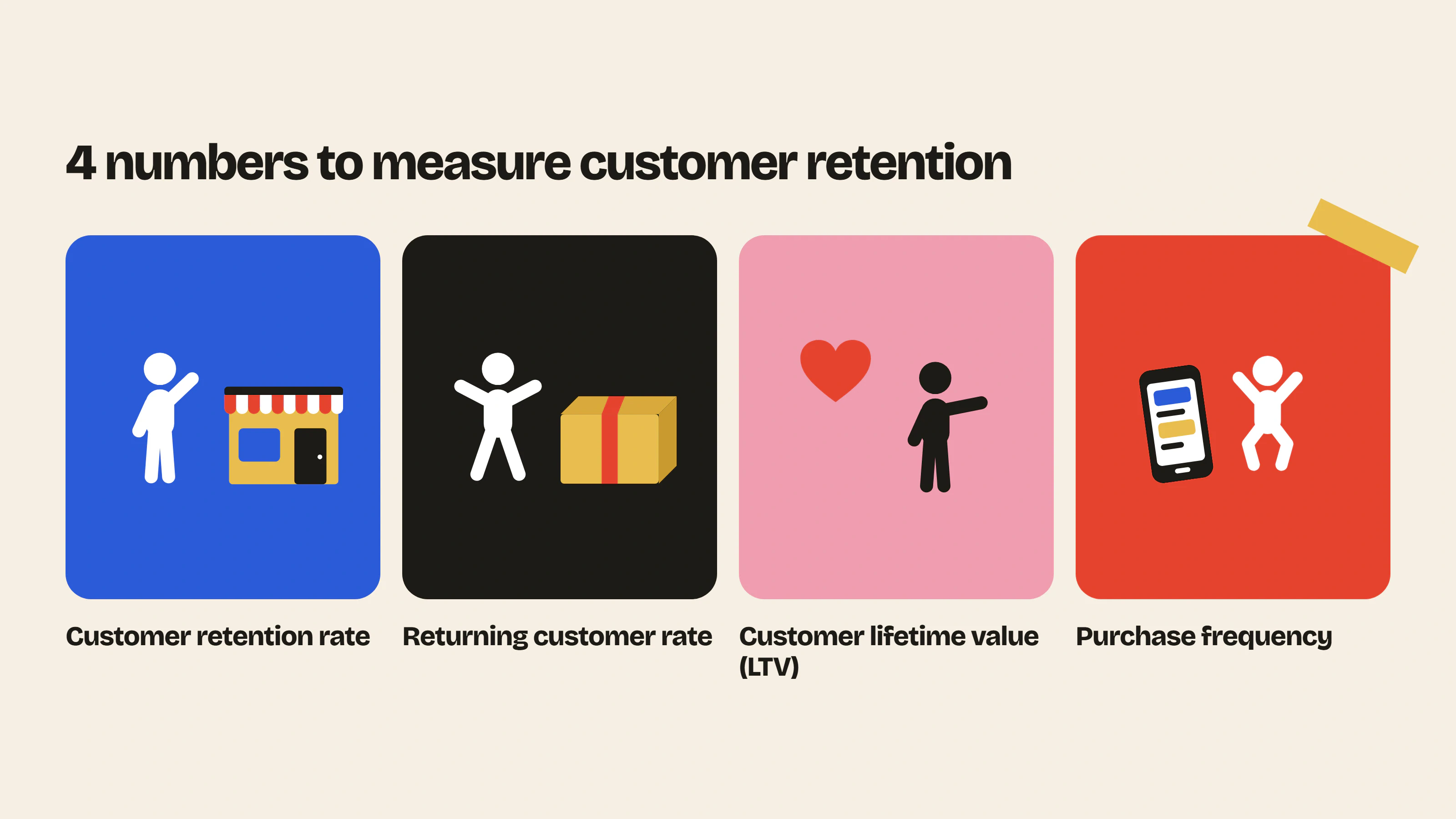
Before you change anything, write down where you stand. We recommend tracking four numbers and an export of your Shopify orders is enough to calculate all of them.
Customer retention rate
It’s the share of customers from one period who bought again in the next one. For example, if 800 customers ordered from you in the first half of the year and 200 of them ordered again in the second half, your retention rate is 25%.
Pick a period that matches how often your customers buy. A month makes sense for coffee or supplements, while for hiking boots you’d rather count six months or a year.
Returning customer rate
These are the customers who ordered at least twice. Out of 2,000 customers in a year, if 460 placed at least two orders, your rate is 23%. It’s quick to calculate, so it’s the one we suggest checking every month.
Customer lifetime value (LTV)
It’s the margin a customer leaves you over the whole time they buy from you. You get it by multiplying the margin per order by the number of orders per year, then by the number of years. It tells you the maximum you can spend to win a customer and keep them. To calculate the LTV and compare it with your acquisition cost, there’s our customer lifetime value calculator.
Purchase frequency
It’s the average number of orders per customer over a year. Of the four numbers, it’s the one you have the most control over. With $30 of margin per order, a customer who goes from 1.8 to 2.4 orders a year leaves you $18 more margin every year.
How to retain customers: 12 ecommerce retention strategies
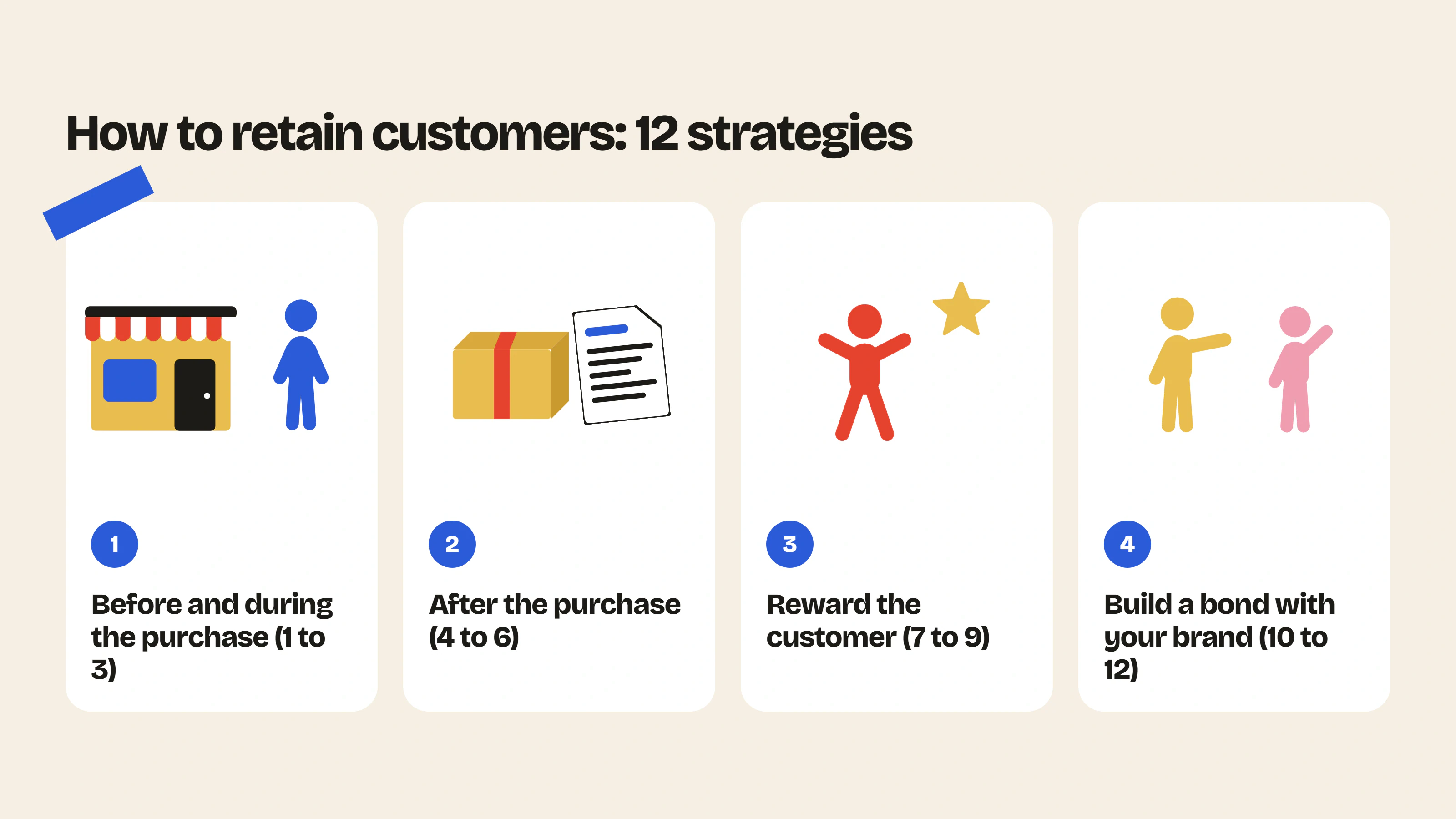
To retain customers, several strategies add up. We’ve listed them in the order of a customer’s life. Strategies 1 to 3 happen before and during the purchase, 4 to 6 after it. Strategies 7 to 9 reward the customer and 10 to 12 build a bond with your brand.
A tip: if you could only do two, start with the post-delivery email (4) and the review request (5).
| Strategy | Time to get it going | Cost | When to start |
|---|---|---|---|
| 1. A simple checkout | An hour a month to test | None | As soon as possible |
| 2. Reliable delivery | A few hours | Depends on the carrier | As soon as possible |
| 3. Fast customer support | Every day | Your time | As soon as possible |
| 4. The post-delivery email | Half a day | Your email tool | As soon as possible |
| 5. The review request | Half a day | A reviews app | As soon as possible |
| 6. Follow-ups | Half a day | Your email tool | If your products get used up |
| 7. Points or tiers | A few days | A loyalty app | When customers already buy again |
| 8. Gamification | A few days | Depends on the tool | When you have regular customers |
| 9. Referrals | A day | The discounts you offer | When your customers are happy |
| 10. A community | A few weeks to launch | An app, with or without a free plan | From a few dozen loyal customers |
| 11. Your customers’ content | A little every week | None | From the first reviews and photos |
| 12. Involving customers | Now and then | None | Before a product launch |
These are our estimates for a small store, to adjust to your situation.
1. A simple checkout, from cart to confirmation
A customer who struggled to order the first time will think twice before doing it again. The easiest check is to place an order yourself on mobile once a month, as a customer would. You’ll see right away if something gets in the way, such as mandatory account creation or shipping costs that only show up at the last step.
2. Delivery that keeps its promises
Announce a lead time you can keep, even if it’s a little longer than your competitors’. And when a parcel is delayed, let the customer know quickly if you have the information.
3. Fast customer support
Reply on the channel the customer chose and offer a solution in your first message. For questions that keep coming back (sizes, care, lead times), write the answer once and for all in an FAQ. You can also let your customers answer each other in a help forum.
If you’re hesitating between the two, we compared the best FAQ apps for Shopify. And to get an idea of the time you’d save, our customer support savings calculator runs the numbers for you.
4. A post-delivery email to help them use the product
This is the email we recommend setting up first. It goes out two or three days after delivery, once the parcel has been opened. Its job is to help the customer get the most out of what they just bought. Put in instructions clearer than the leaflet, a care tip or an idea they wouldn’t have thought of.
Keep promotions for another email. A discount code in this one makes it look like you’re already thinking about the next order, when the customer has only just received the first.
And if your products take some getting used to (shoes that need breaking in, a cream to apply for several weeks), add a second email around day 15. It’s there to reassure the customer before they judge the product on its first few days.
5. Ask for a review
About ten days after delivery, ask the customer what they think of the product. Give them time to use it (a review requested on the day of delivery is mostly about the parcel).
And reply to reviews, including the negative ones. Hesitant visitors read them to see how you react when something goes wrong.
6. Follow up at the right time
For a product that gets used up, you know roughly when the customer will run out. If a jar of cream lasts two months, a reminder around day 50 lands right on time. For this kind of product, also think about a subscription, with a small discount for customers who agree to be delivered at a fixed interval.
7. A points or tier program
Customers earn points on every purchase and exchange them for a discount or a gift. Tiers (silver, gold…) give them a goal, because people want to keep their level.
Just watch out for the rules. If customers can’t understand in one sentence how it works, they lose track of what they’ve earned and end up forgetting the program.
8. Gamification
Challenges, badges, milestones: gamification turns some actions into a game, such as sharing a photo of a product, leaving a review or answering another customer’s question. It works when those actions make sense for your customers and for your brand.
9. Referrals
A discount for the customer who refers, another for the friend who orders. The idea is well known and it does two things at once: it keeps your customers and brings you new ones. On top of that, the new customer arrives with the recommendation of someone they know, which reassures them before their first order.
10. A customer community
This is the strategy we know best, since it’s our job. A community is your customers talking to each other about your products: they ask questions, share photos, give each other tips. So they come back to your site between two orders, to read an answer or give one, and every visit puts your new products in front of them again.
Over time, members also get attached to each other. It’s hard to picture a customer who helps others on your forum every week leaving for a competitor overnight.
Then you have to choose where to host it. A Facebook group or a Discord server? Easy to create but the conversations happen on their platform, away from your brand. A forum on your store keeps the conversations with you, next to your product pages. If you’re unsure, we compare the options in our article on community platforms. And for the launch, everything is explained step by step in our guide on how to build a brand community.
It takes a bit of time at the start: you need to post the first topics yourself and reply quickly for a few weeks. That’s why we place it after the post-purchase emails, which run on their own once they’re set up.
11. Show your customers’ content
Share your customers’ photos and reviews on your product pages, in your emails and on social media, with their permission and with credit. Visitors see people like them using the product and the customer you feature is usually happy about it (ask them first anyway). This content also helps your search rankings, we explain why in our article on user-generated content and SEO.
12. Involve customers in your decisions
Let customers vote on the next color or on the return of a sold-out model, and offer your most active customers the chance to test a product before launch. A customer who voted for a color wants to see the result, and on launch day, they’re the first one you tell.
Customer retention examples
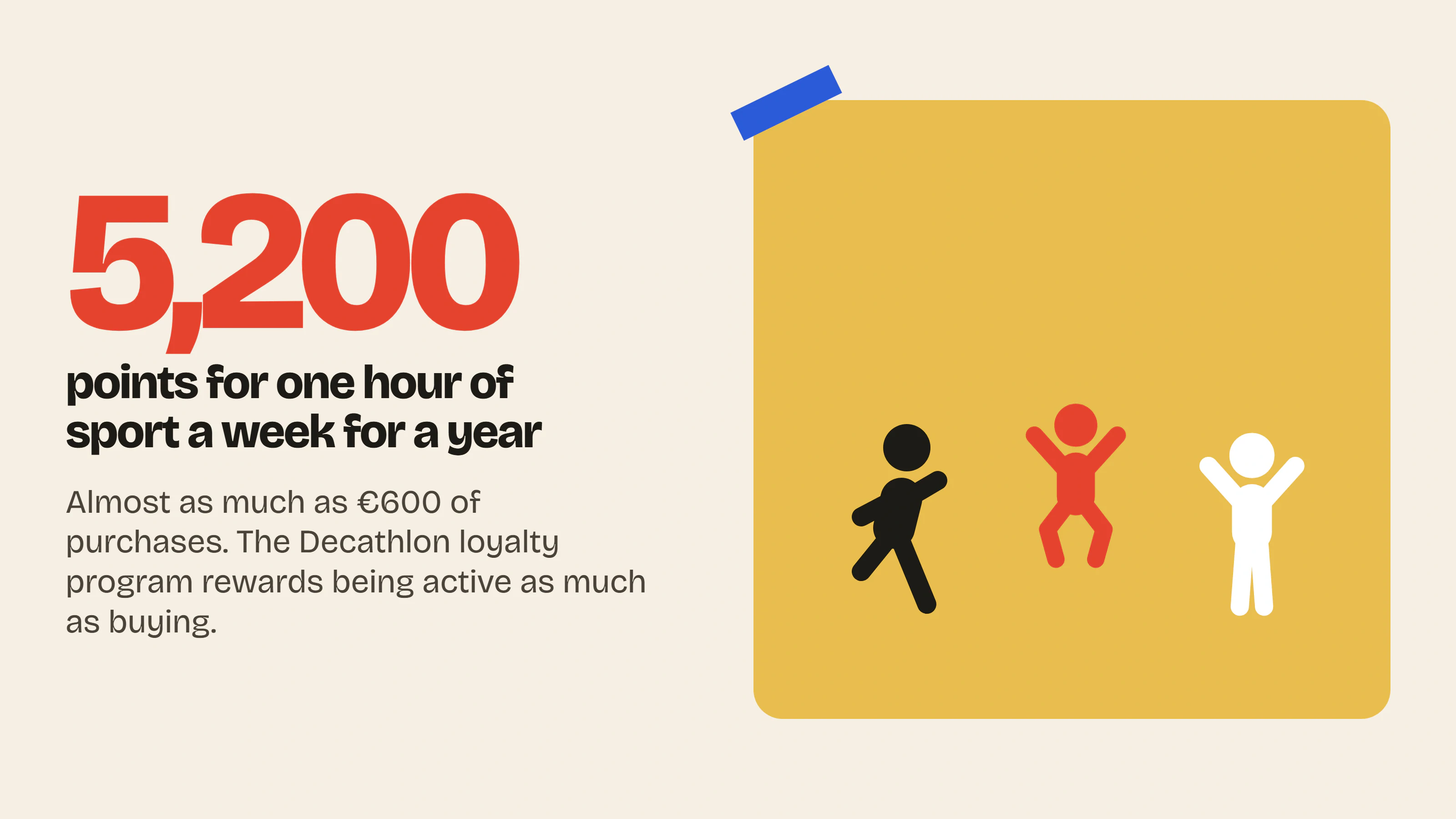
Here are two programs from large brands, based on their official pages as viewed on November 10, 2026. Their budgets have nothing in common with a Shopify store’s, but their ideas work very well on a small scale.
Decathlon: points for doing sport
The Decathlon loyalty program in France gives 10 points per euro spent. It also gives points for actions that aren’t purchases. A product review earns 10 points, one hour of sport per week 100 points, and the same goes for a circular economy action (resale, buy-back or rental). Points are exchanged for vouchers, from €3 for 2,000 points to €10 for 6,000 points.
Do the math. On purchases alone, you need to spend €600 to get a €10 voucher. One hour of sport a week for a year earns 5,200 points, almost as much. So the program rewards being active as much as buying. For a small brand, the idea to borrow is to also reward the actions that matter to you: a review, a photo, an answer to another customer.
Sephora: new rewards twice a week
In the US, members of Sephora’s Beauty Insider program exchange their points for products and new rewards drop every Tuesday and Thursday. Members get free shipping and the Auto-Replenish subscription gives 5% off products they buy regularly. Sephora also runs a community gallery where members share their looks and hauls in photos and videos.
The smartest idea is the Tuesday and Thursday rewards. They bring members back to the site even when they have nothing to buy.
Mistakes that drive loyal customers away
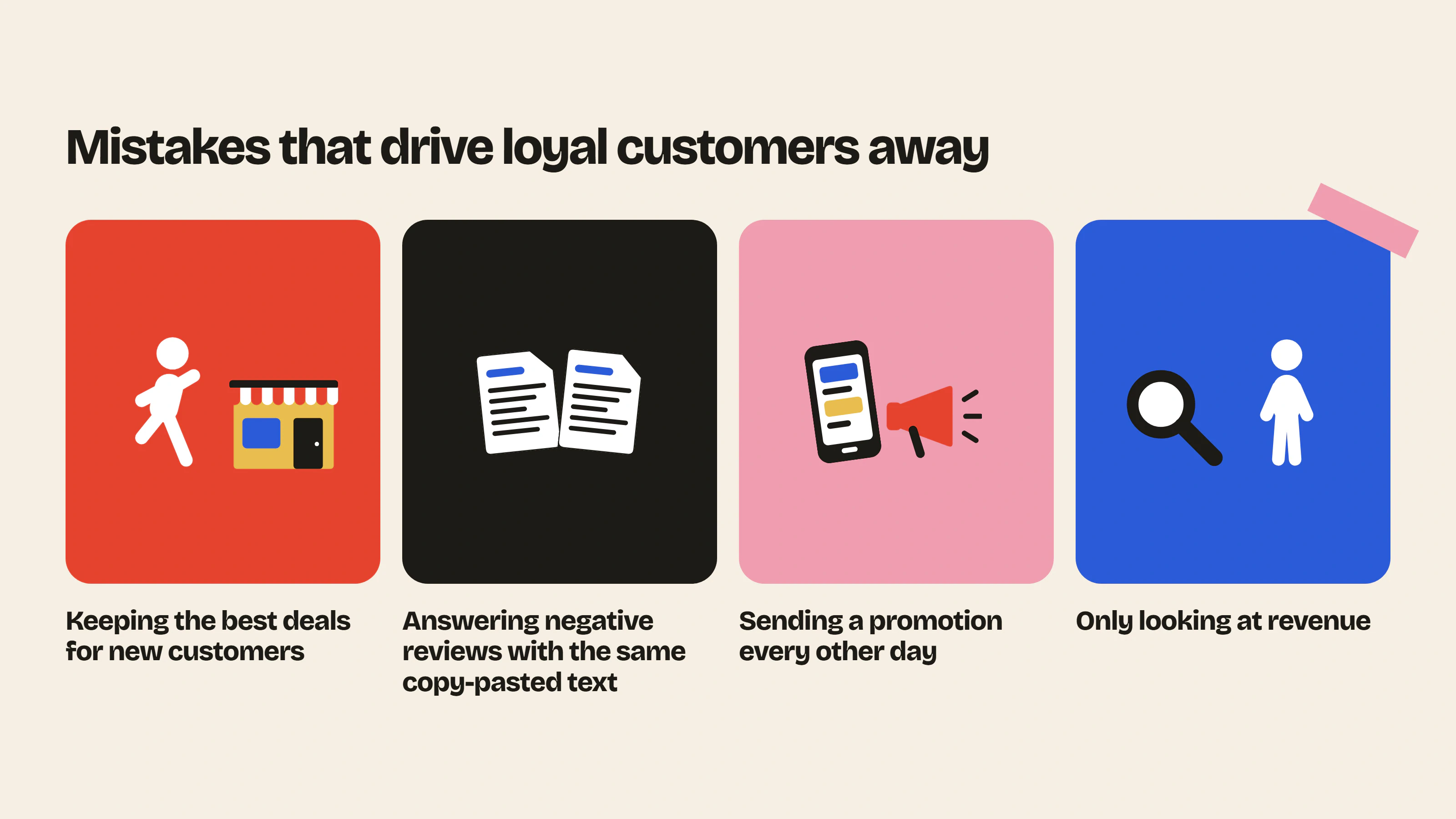
Here are the ones we see most often:
- Keeping the best deals for new customers. If the first purchase is 30% off and your loyal customers never get anything, they quickly understand they’re better off creating a new account.
- Answering negative reviews with the same copy-pasted text.
- Sending a promotion every other day. The customer ends up unsubscribing and you lose the cheapest channel to bring them back.
- Only looking at revenue. Rising sales can come entirely from new customers and hide falling retention.
Insider Club: a customer community on your Shopify store
If strategy 10 speaks to you, that’s exactly what Insider Club does. The app adds a forum to your Shopify store, built into your theme, and customers logged into their account are members without having to create a password.
You can show the latest posts on any page of the store, moderate conversations and follow activity in the analytics. An email alert lets you know about every new post. The free plan covers unlimited members and posts.
The Growth plan adds roles and badges for your most active members, private categories and polls (handy for strategy 12). You’ll find everything on the features page. And if you want to compare before choosing, we reviewed the forum apps for Shopify.
FAQ
What is a good returning customer rate in ecommerce?
There’s no figure that works for every store. A supplement brand selling monthly courses will have far more returning customers than a mattress brand that people replace after many years. The best benchmark is your own number: write it down today and see how it changes every month.
How much does a customer retention strategy cost?
The strategies before and after the purchase mostly cost time. A points program or a community needs an app, whose price depends on the tool and the size of your store (Insider Club has a free plan and a Growth plan at $19.99 a month). Either way, the biggest cost is the time spent answering reviews and running the community.
When should you launch a loyalty program?
When some of your customers already buy again on their own. If almost nobody comes back, a points program won’t change much. First look for what’s holding customers back, on the product side or in your delivery times.
How can you attract and retain customers at the same time?
Referrals do both, since a loyal customer brings you a new one. So does a community open to visitors: a future customer reads your current customers’ answers there before ordering.
How do you retain B2B customers?
The principles are the same, with fewer customers and bigger orders. What matters most, in our view, is a contact person who knows the account well and simple reordering, with saved prices and one-click orders. And if you sell to resellers, a private space where they share their selling tips does the job of a community.
- Customer lifetime value (LTV) calculatorWhat a customer is worth over their lifetime, your LTV to CAC ratio and the effect of one more order per customer.Use the tool – Customer lifetime value (LTV) calculator
- Customer acquisition cost (CAC) calculatorYour CAC, profit on the first order, orders needed to pay it back and your customer value to CAC ratio.Use the tool – Customer acquisition cost (CAC) calculator
 Install on Shopify